
Documented NY: PPL’s E-Verify Use Adds to Growing CDPAP Controversy
Home care advocates warn that requiring the use of E-Verify, the federal employment verification program, could incorrectly bar immigrant workers from the industry and disrupt New York's CDPAP program.
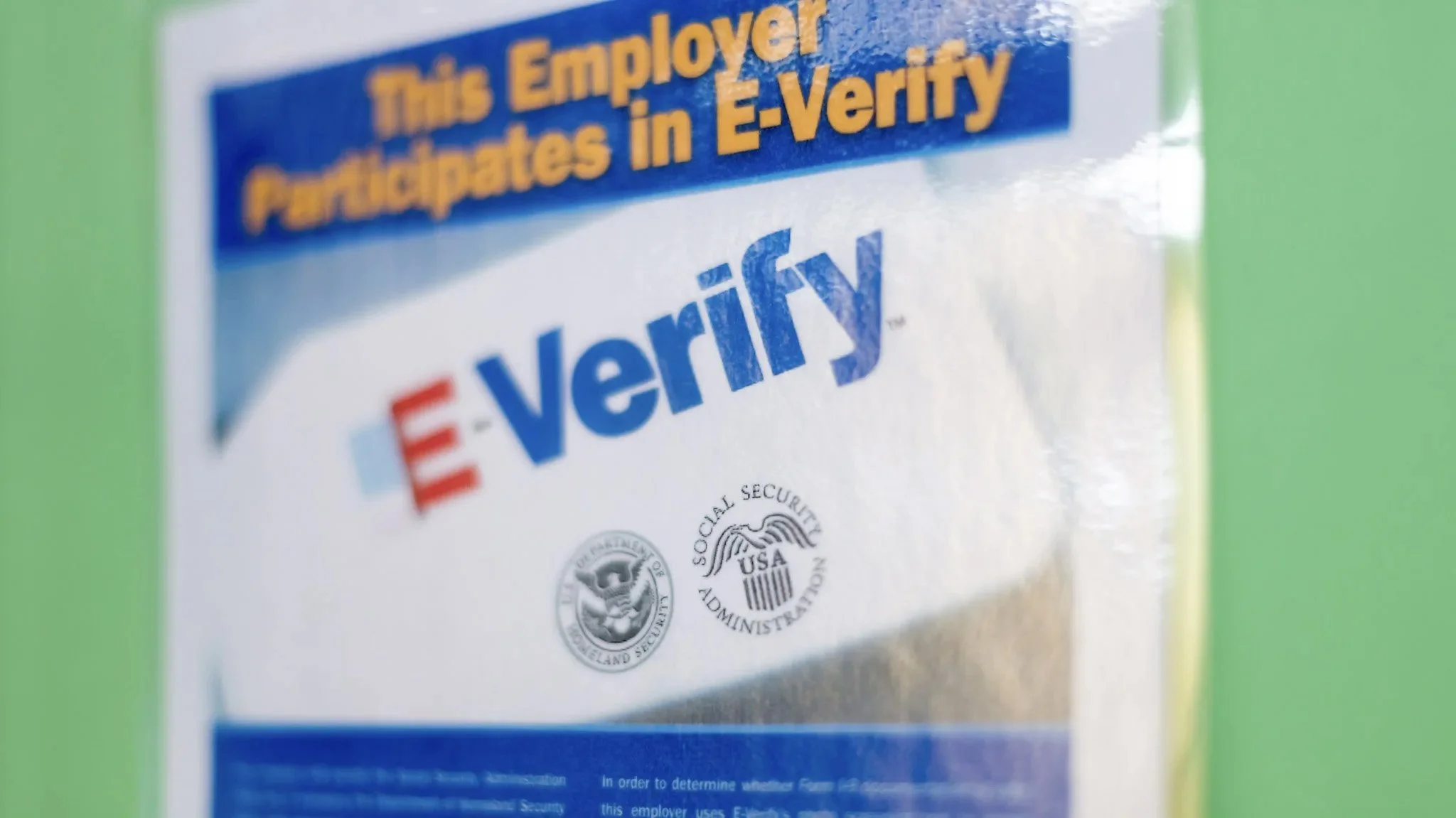
Fairfax, USA - September 29, 2018: Job E-verify employer regulations sign on board post poster information in Virginia office. Photo: Shutterstock
Read the full article in Documented NY
Sep 29, 2025
Home care advocates say the use of the federal E-Verify program could push undocumented immigrant home care workers out of the industry. The new development continues to mount pressure on Gov. Kathy Hochul’s controversial revamp of the Consumer-Directed Personal Assistance Program, also known as CDPAP.
Beginning on April 1, the state consolidated the CDPAP program, which allows relatives or caregivers of disabled individuals on Medicaid to get paid for their care, under a single statewide fiscal intermediary, Public Partnerships LLC (PPL).
Prior to the transition, the program, which serves 280,000 New Yorkers and employs as many as 400,000 workers, was operated by over 600 home care agencies. Many of those agencies, which operated within immigrant communities and hired mostly immigrant home care workers, didn’t require workers to register with E-Verify. In New York City, 73% of home health care workers are immigrant women of color.
E-Verify was first initiated as a pilot program in 1996 as part of the Immigration Reform and Immigrant Responsibility Act. Operated by U.S. Citizenship and Immigration Services, it is a federal government-operated database that allows employers to electronically verify if their employees are authorized to work in the United States.
It has been heavily criticized by both immigrant rights organizations and civil liberty groups for the potential to bar immigrants from the job market due to falsely claiming they are not eligible to work in the United States, even though they are.
But since PPL became the single statewide fiscal intermediary for CDPAP in April, the company has been requiring home care workers to verify their legal work authorization status through the use of E-Verify, although no law states that they need to do so.
Critics of PPL’s takeover of CDPAP, such as Ilana Berger, political director of Caring Majority Rising, an advocacy group representing home care workers and people with disabilities, say that PPL’s use of E-Verify is hurting undocumented home care workers by pushing them out of the job market.
“These workers are now caught in PPL’s bureaucratic chaos, just like the hundreds of thousands of other New Yorkers who have struggled with PPL’s broken systems for months,” she said in a statement to Documented. “PPL has failed at every basic function, whether it’s processing immigration paperwork, physicals, and payroll.”
E-Verify compares information from employees’ I-9 forms with records from the Department of Homeland Security (DHS) and the Social Security Administration (SSA) to determine if an immigrant is legally authorized to work in the country.
Unlike I-9 forms, which are forms all employers must require of their employees hired at a worksite to complete to verify their work authorization as required by law, federal law does not mandate private employers to use E-Verify, as it is optional for most private employers.
Jessie Hahn, senior counsel on labor and employment policy at The National Immigration Law Center (NILC), said that it’s not the role of employers to act as immigration officials when a new employee is filling out a paper I-9 form.
“The employer is not required to be a document expert,” she told Documented. “If the employee provides documents that appear reliable and relate to the individual who is presenting them, that is sufficient for the employer to meet their responsibilities under the federal law. They don’t even have to keep copies of the documents, just copies of the I-9 form.”
Only federal contractors and subcontractors with contracts valued at more than $3,500 in commercial or non-commercial services or construction are required to be enrolled in E-Verify. On the state level, no federal law requires states to use E-Verify for state programs such as CDPAP. But despite the voluntary nature of E-Verify, 22, predominantly Republican states require employers to use E-Verify in some form because of widespread anti-immigrant sentiments.
New York is among the 24 states that don’t require the use of E-Verify. Only two states, California and Illinois, completely restrict the use of E-Verify because of its potential use in unfair immigration-related employment practices, such as retaliation against workers for exercising their workplace labor rights.
“Here’s the problem with E-Verify: it’s not foolproof, as it does not detect identity fraud,” said Hahn. “In other words, it generates both false negatives and false positives. False positives, meaning people who are not actually who they say they are, are being allowed through the system, and people presenting valid documents are being flagged by the system as not work-authorized while in fact they are.”
When Arizona mandated that all employees in the state register with E-Verify in 2007, immigrant workers moved into the underground economy, depriving the state of income-tax revenue at the same time the state was facing a $1.2 billion budget deficit.
Technical issues with E-Verify are not new, with even the Trump administration admitting that the program is flawed. In 2013, a NILC report found that if the entire U.S. workforce were required to use E-Verify, almost 3.5 million U.S. citizens and authorized immigrants would either have their records flagged for correction or face losing their jobs, with about 77,000 to 221,000 citizen and authorized immigrant workers in New York having to correct their records.
The report also found that immigrant workers are 20 times more likely to receive an E-Verify error than U.S.-born employees due to variables such as employers misspelling workers’ names.
And when employers use E-Verify to vet the status of their employees, the system isn’t always accurate. In July, an ICE raid at a meatpacking plant in Omaha, Nebraska, led to the arrest of more than 70 workers for not being legally authorized to work in the U.S. According to the CBS report, the plant’s owner claimed to have only hired his employees after he vetted their status through E-Verify.
Because of the various problems of reliability with E-Verify, New York State Senator Jessica Ramos introduced a bill in 2020 that would prohibit employers from using E-Verify to check the employment authorization status of existing employees or prospective employees.
“The E-Verify system is flawed, which is why I want to make it illegal to require these E-Verify checks in New York,” she said in a January 2020 statement. “We need to protect undocumented immigrants who are here in search of safety and economic opportunity, and I believe my bill will do just that.”
Still, PPL continues to use E-Verify in its hiring process despite not having a mandate to do so from the state. PPL is also active in Georgia, which does require the use of E-Verify.