
The New York Times: N.Y. Lawmakers Press Officials About Home Health Program’s Issues
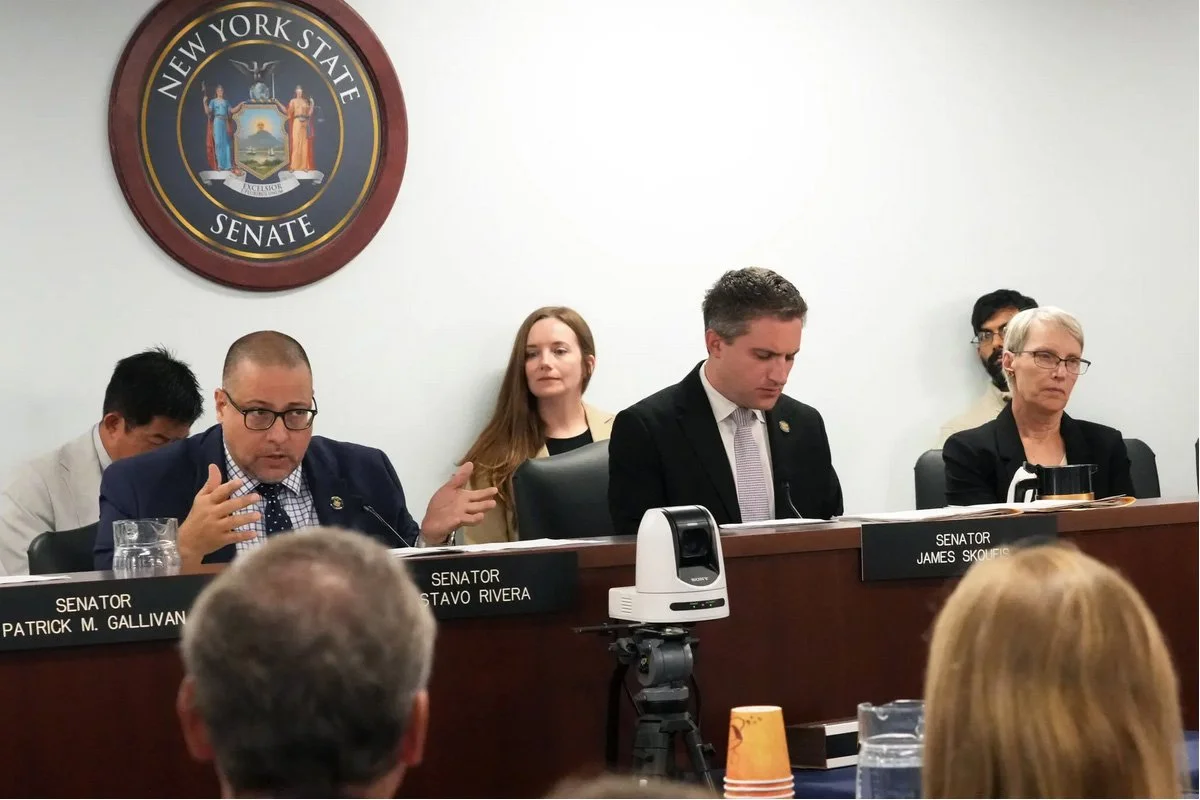
State Senator Gustavo Rivera, left, grilled a state official about a program for home health care that has been plagued with issues in recent years.Credit...Michelle V. Agins/The New York Times
Click here to read the piece in the New York Times
Published Aug. 21, 2025 | Updated Aug. 25, 2025
The program had a simple mission: to allow disabled and chronically ill New Yorkers to live at home, instead of in nursing centers, while receiving care.
But in the year since the state pushed to consolidate its operations, with a goal of saving $500 million each year, the program has devolved into a logistical and political nightmare: Caretakers report late and missing pay. Patients worry they will be left alone, without the care they need to manage daily tasks.
The state says everything is working just fine.
It was this clash of narratives that drove an hourslong hearing on Thursday that was by turns somber and explosive. Democratic and Republican senators alike seized the opportunity to grill the health commissioner and the program operator about the transition, which has thrown the beloved program into disarray.
Dr. James V. McDonald, who leads the State Health Department, defended the state’s decision to employ the firm, Public Partnerships L.L.C., which he said was in “full compliance” with its contract. But when pressed for details about how the state had evaluated the performance of the contractor, and the outcome of the transition more broadly, Dr. McDonald repeatedly deflected, saying he had not prepared answers to those questions.
“Do you not believe the numbers are important?” a frustrated Senator Gustavo Rivera, a Democrat who chairs the Health Committee, asked after one such exchange.
“Of course I do,” Dr. McDonald replied.
“Then why don’t you have them with you?” Mr. Rivera asked.
The Consumer Directed Personal Assistance Program, or C.D.P.A.P., was established in 1995 with the goal of providing disabled and chronically ill New Yorkers more autonomy over their lives and care while helping the state avoid the greater expense of institutionalization.
Central to the program’s operation were the many entities that sprang up to handle payroll and program compliance for caregivers. Called fiscal intermediaries, these groups varied greatly across the state — some operating as large nonprofits, others serving small cultural enclaves from Rochester to Flushing, Queens.
These intermediaries operated with few guardrails, and over time their numbers exploded. By last year, the state estimated that there were more than 600 across the state — each with an incentive to enroll as many patients as possible.
In 2017, the program served 12,000 New Yorkers for $1.5 billion. Six years later, it was projected to grow to serve a quarter of a million people at a cost of $11.2 billion, straining the state budget.
In 2023, Gov. Kathy Hochul pushed to consolidate all care under a single fiscal intermediary, which she said would provide savings by offering economies of scale, standardizing pay for caregivers and jump-starting an anti-fraud measure long required by the federal government. All of this, the proposal went, without cutting anyone’s care.
The issues began to arise almost as soon as Public Partnerships took over.
Patients and caregivers alike complained about website glitches, missing paychecks and endless wait times when they called the company with problems.
And while some were able to use the app, which electronically verified that a caregiver was working without issues, others, like Angela Harmer of Troy, faced serious headwinds. Ms. Harmer, 50, has been part of the C.D.P.A.P. program for 22 years to help her manage her cerebral palsy.
Ms. Harmer said that while she could use a telephone, apps were not practical for her between her mobility issues and the fact that her building does not provide Wi-Fi. She is afraid that she could lose the care that has allowed her to live an independent and meaningful life. She said she had been without service for two weeks while Public Partnerships sorted out a payroll problem.
“Consumer Direct is a program that was created by disabled people, for disabled people,” she added tearfully. “This is not the way it was supposed to end up.”
Patty Byrnes, the vice president of government relations for Public Partnerships, said at Thursday’s hearing that the company had been working hard to take over the large and unwieldy program. It had signed up 233,000 patients and paid $2.3 billion in wages, she said, and was “committed to transparency, accessibility and responsiveness.”
Public Partnerships has acknowledged that the initial rollout was bumpy but blamed many of the problems on fiscal intermediaries who, the company said, had not only withheld information but actively sabotaged the process by telling patients not to register with the new company.
Other supposed hiccups were the result of newly imposed oversight measures, the company said, including location verification, consumer approvals and the removal of duplicate hours for caregivers that had led to overpayment.
The state had promised that the transition would help crack down on fraud, like a $68 million Medicaid fraud scheme charged in 2024, as well as accusations of wage theft against intermediaries that paid their executives hundreds of thousands of dollars each year, according to the 2022 Home Care Cost report.
Disability activists say that those cases represent the statistical minority, however. They point to a 2022 audit from the state’s Office of the Medicaid Inspector General that found 99 percent claim accuracy.
Even so, state officials said the consolidation was necessary to protect the long-term viability of the program. Kathryn Garcia, the director of state operations, said the incentive for intermediaries to constantly sign up more people was one of several “big structural problems” in the design of the program that had become “urgent” for the state.
“Every time you turn around, it’s costing you an extra billion or two,” Ms. Garcia said in April. “Even in the state of New York, we cannot do things like that.”
State officials dismissed much of the outcry as misinformation pushed by special interests, like the $10 million spent by the industry-backed Alliance to Protect Home Care.
Since then, Public Partnerships’ problems have only continued to mount. A recent survey of 235 caregivers and recipients from the nonprofit Caring Majority Rising, which has led much of the activism against the transition, found that just 51 percent of English-speaking caregivers who responded had been fully paid for all of the hours they had worked. The result was even starker among Spanish-speaking workers, 82 percent of whom reported missing pay. Public Partnerships has dismissed the survey and points to its own, which shows greater satisfaction.
In July, The New York Post reported that an employee at Public Partnerships had falsified direct deposit information, directing the funds into fraudulent bank accounts. This came on the heels of reporting in New York Focus that the company that Public Partnerships had tapped to handle caregivers’ health insurance, Leading Edge, had excluded basic care and was founded by a man who had been convicted of insurance fraud.
The company’s representative, Ms. Byrnes, said on Thursday that the person responsible for the fraud was a third-party contractor, who had since been fired. She added that no caregiver money had been misdirected and that additional protocols had been instituted. She also suggested that the company was looking at alternative options for health insurance, but she offered no firm commitments.
This summer, the company’s chief executive, chief financial officer and president stepped down, raising questions about the company’s long-term viability.
Senator Steven Rhoads, a Republican from Long Island, said on Thursday that he found the leadership changes and the timing to be “incredibly odd.”
Ms. Byrnes said everything was under control and attempted to clarify. “These have been transitions that have been in the process, and are being adequately worked on, in transition to the new incoming personnel,” she said.
Grace Ashford covers New York government and politics for The Times.
A version of this article appears in print on Aug. 23, 2025, Section A, Page 16 of the New York edition with the headline: Lawmakers Seek Answers On Disarray in Home Care.