
Daily News: Why are my caregivers being deported?
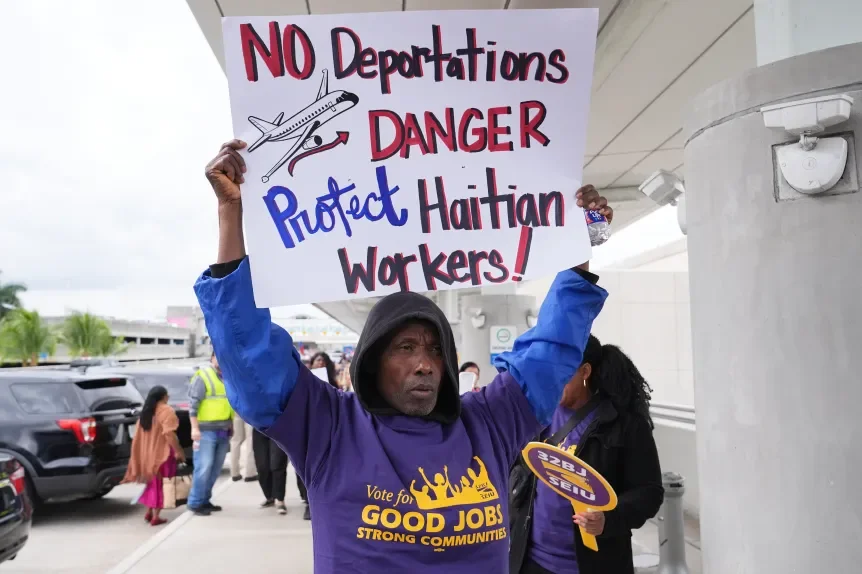
A person marches during a rally in support of the extension of Temporary Protected Status (TPS) for Haitian immigrants before it expires on February 3, Wednesday, Jan. 28, 2026, in Fort Lauderdale, Fla. (AP Photo/Lynne Sladky)
Read full article at the Daily News
PUBLISHED: July 2, 2026 at 5:00 AM EDT
Last week, the U.S. Supreme Court handed down a ruling that most Americans will read about and move on from. I won’t have that luxury.
I am disabled. I rely on home care workers to help me get through each day — getting dressed, preparing meals, and maintaining the basic dignity that so many people take for granted. Some of those workers are Haitian immigrants — as are my parents. And now my caregivers are one step closer to being deported.
Last week, the Supreme Court ruled that the executive branch has virtually unlimited power to end Temporary Protected Status (TPS) — the humanitarian program that has allowed Haitian nationals to live and work legally in the United States, in many cases for years. The practical effect is this: roughly 350,000 Haitians who have been living here lawfully, working, paying taxes, raising families, and caring for people like me could now be deported.
I want people to understand what that actually means for all of us.
The home care workforce in this country is in crisis. There are not enough people willing to do this work, which is physically demanding, emotionally taxing, and chronically underpaid. Haitian workers have stepped into that gap in enormous numbers, particularly in New York and Florida. Finding care workers I trust — people who know my needs, my routines — is not something that can be replaced by other workers, or AI or technology.
The Supreme Court’s majority said the administration’s decision to revoke TPS for Haitians was not racially motivated, despite a record in which President Trump called Haiti a “s---hole country,” claimed Haitians “probably have AIDS,” and said their presence in America was “like a death wish for our country.” Justice Elena Kagan, writing in dissent, was blunter. Those statements, she wrote, “fairly shout, in their racial undertones and overtones alike, that race entered into the president’s resolve to remove Haitians from this country.”
I’m not a legal scholar. But I know what racism sounds like. And I know who pays the price when it becomes policy.
The people being sent back are mothers, fathers, friends and neighbors. They are nurses and home health aides and hospital workers. They are the people who showed up during COVID when everyone else stayed home. They built lives here in good faith, under a legal program that the U.S. government invited them into. Many have American-born children who are citizens. The ruling rips those families apart.
This ruling also upends care and support for disabled and elderly Americans. Anyone who depends on care workers will be affected by this ruling. Hospitals will be impacted. Nursing homes will reel from it. The home care system — already stretched to breaking — will feel it acutely. We’re not a special interest. We are millions of people who simply need help to live.
Congress can still act. The House has already expressed support for protecting Haitian TPS holders, and advocates are calling on the Senate to move legislation that would extend those protections. That must happen.
In the meantime, I am asking everyone who reads this to understand that immigration policy decisions aren’t abstractions. Its impact is felt in people’s homes. It lands in my home. When the workers who make my life possible are forced to return to a country where people are dying in the streets, that’s a matter of life-and-death for both of us.
The Supreme Court may have closed the courthouse doors. Congress must open another way. Our families were made stronger by the contributions of our care workers. Now it’s time for us to help them keep theirs together, too.
Joseph is an advocate for people with disabilities and a Leader at NY Caring Majority